
Many partners and parents who contact us are worn out. They have paid debts, made excuses, pleaded, argued and threatened to leave. Then someone tells them to step back and let the person hit rock bottom, and waiting for that moment starts to feel like the only option left.
If you are there, it makes sense that you are tired. There is another way to respond, and it has research behind it.
Two directions families get pulled in
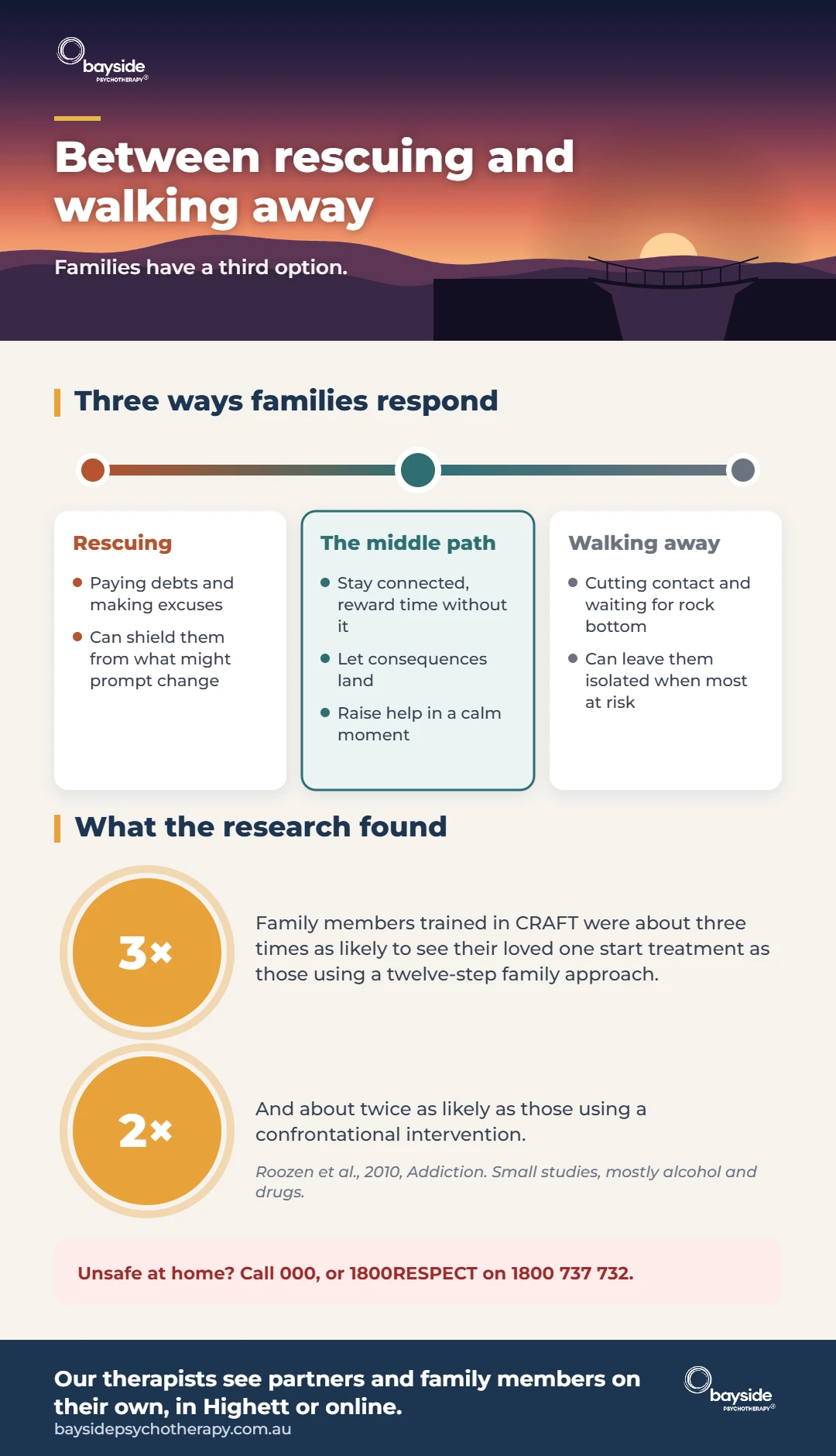
In our experience, families tend to swing between two responses. One is rescuing: paying the debt, covering for a missed shift, smoothing things over so the household keeps running. The other is pulling away completely and waiting for things to get bad enough.
Both make sense. Rescuing can shield someone from the consequences that might prompt change. Pulling away can leave them isolated when they are most at risk, and rock bottom can be dangerous, or arrive far too late.
A middle path with research behind it
CRAFT (Community Reinforcement and Family Training) teaches family members to stay connected while changing how they respond. A review of the trials found that family members trained in CRAFT were about three times as likely to see their loved one start treatment as those using a twelve-step family support approach, and about twice as likely as those using a confrontational intervention. Family members’ own mood improved too (Roozen and colleagues, 2010). The studies were small and mostly about alcohol and drugs, so the exact size of the benefit is uncertain.
What this can look like day to day
- Notice and respond warmly to the times they are not drinking, using or gambling.
- Step back from covering up, so they deal with the bank, the boss or the missed event themselves.
- Choose a calm moment to say what you have noticed and suggest help, and avoid starting that conversation mid-crisis.
- Keep money and safety boundaries clear, especially where there are gambling debts.
- Get support for yourself, whether or not they change.
What CRAFT involves
CRAFT was developed in the United States for families of people who drink or use drugs, and its ideas are now used more widely, including with gambling. It works with you, the family member, on your own. Over a number of sessions you learn to:
- spot the patterns and triggers around the drinking, using or gambling
- make time without it more rewarding for both of you
- let the costs of using fall where they belong
- talk in ways that are less likely to start a fight
- choose the right moment to suggest treatment
- look after your own health and safety
It doesn’t need the person to agree to anything. Many family members find it helps them feel less helpless, whatever the other person decides. When you call a support service, it is worth asking whether they offer CRAFT or a family program based on it.
How to raise help in a calm moment
Timing matters. A good moment is often when the person is sober, rested and has just shown some regret, or soon after a consequence has landed. Poor moments include the middle of an argument, while they are drunk or high, or straight after a big loss.
Keep it short and specific, start with what you care about, and offer one clear step. For example:
“I love you and I miss how things were. I’m worried about the money and about us. Would you come with me to talk to someone this week? I’ve found a counsellor who can see us online.”
If they say no, you haven’t failed. Leave the door open, keep looking after yourself, and try again at another calm moment.
Money and gambling debts
Paying off someone’s debt can bring short-term relief and longer-term risk. The pressure that might push them towards help disappears, and the debt can come back. Before you pay anything, get advice.
- The National Debt Helpline (1800 007 007) offers free financial counselling.
- Gambler’s Help offers free counselling and financial counselling to family members as well as people who gamble.
- Keep your own savings and income separate where you can, and don’t sign loans or guarantees under pressure.
When stepping back is the right call
Staying connected doesn’t mean putting up with anything. It can be right to step back, live apart or end the relationship if you or your children are unsafe, if your own health is suffering badly, or if you have tried for a long time and nothing is changing. Stepping back to protect yourself is different from waiting for rock bottom, and you can still make it clear that help is there if they want it.
When your safety comes first
If there is violence, threats or controlling behaviour, your safety and your children’s safety come first. In an emergency call 000. For confidential support, call 1800RESPECT on 1800 737 732.
Support for you
You don’t need the person to come with you to get help. Family Drug Support (1300 368 186) and Gambler’s Help (1800 858 858) are free and available 24/7. Our therapists also see partners and family members on their own, in Highett or online.
Common questions from families
Is paying their debts enabling?
It can be. Paying a debt once in a crisis, such as to keep the house, can be reasonable. Paying repeatedly, or without any agreement about what changes, often keeps the gambling or drinking going. Get financial advice first, and link any help to a clear step, such as seeing a counsellor.
What if they refuse help?
Many people refuse at first. Keep using the approaches above, look after yourself, and ask again at a calm moment. In the CRAFT trials, many people who had refused treatment went on to start it after their family member had some training.
Should I tell them I’m getting support?
That’s up to you. Some people say, “I’m seeing someone to work out how to handle this better,” because it shows change is possible without blame. Others keep it private for a while. Both are fine.
Can I see a therapist at Bayside about someone else’s addiction?
Yes. Our therapists see partners and family members on their own, in Highett or online. Sessions are 50 minutes, from $170.
Read more about gambling, addiction counselling and what we see in practice, or use Find your therapist to see who might suit you.
Reference
Roozen, H. G., de Waart, R., & van der Kroft, P. (2010). Community reinforcement and family training: An effective option to engage treatment-resistant substance-abusing individuals in treatment. Addiction, 105(10), 1729–1738.