



Many people who contact us have tried therapy before and come away disappointed. Some feel they wasted money. Some wonder whether they are the problem. When we ask what didn’t work, the answer usually points to something that can be changed.
The commonest reasons we hear
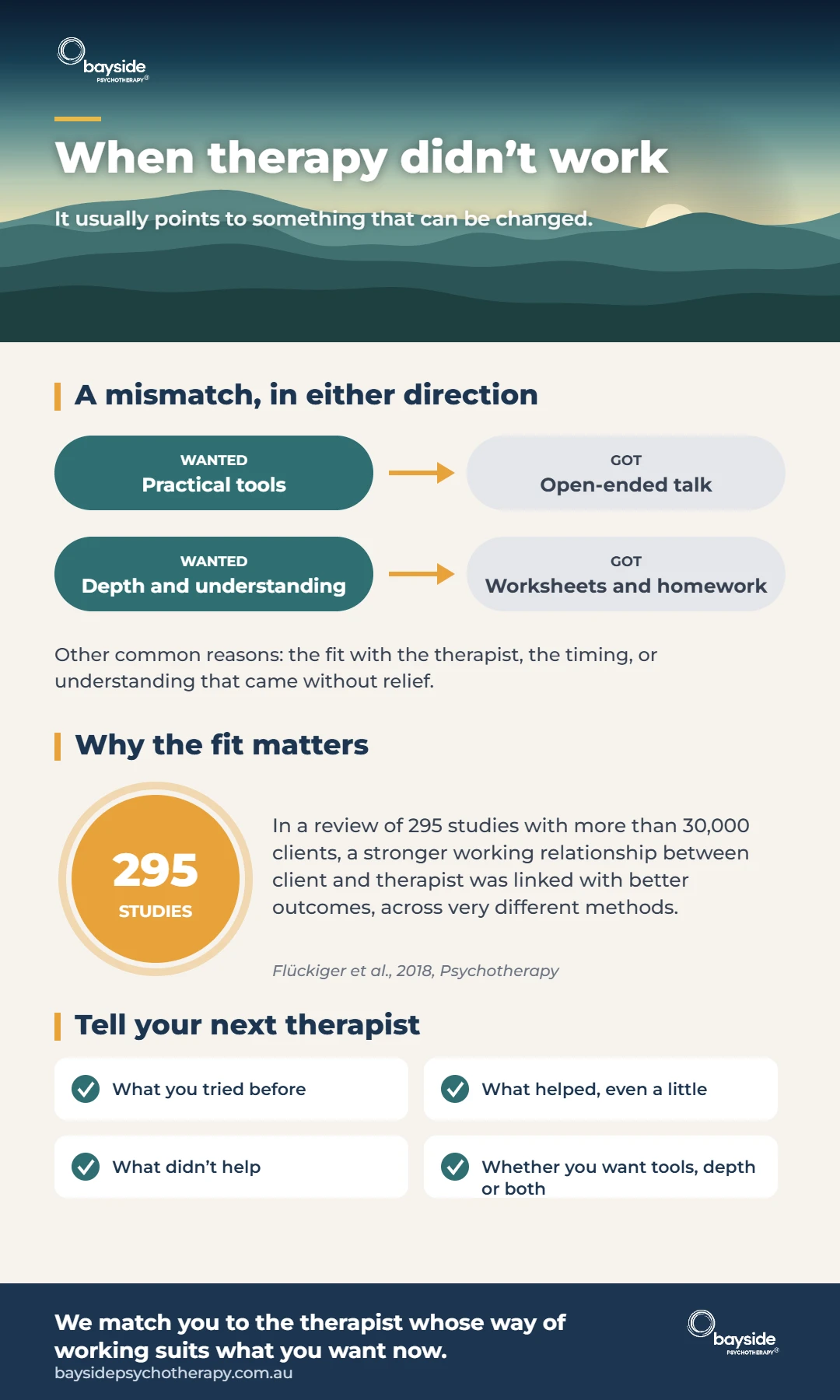
You wanted tools and got open-ended talk. Some people want practical strategies for the next time the panic, urge or argument starts. Weeks of exploring the past can feel like going in circles.
You wanted to understand and got worksheets. Others have already tried techniques and want to know why the problem keeps coming back. Homework sheets can feel like being handed the same advice again.
The fit with the therapist wasn’t right. Feeling understood matters. Across many studies, a stronger working relationship between client and therapist is linked with better outcomes (Flückiger and colleagues, 2018).
It was the wrong time, or it stopped too soon. A crisis, a move or money pressure can cut therapy short before anything has had time to change.
Understanding came, and the suffering stayed. Many people start therapy believing that once they understand their problem, they will feel better. Some leave knowing far more about themselves and still struggling. In psychoanalytic psychotherapy, change comes through the act of speaking itself, in a way unlike everyday conversation. Working through thinking alone can keep the problem neatly explained and firmly in place.
Matching the therapist to what you need
Our therapists work in quite different ways: practical counselling, hypnotherapy, clinical psychology and psychoanalytic psychotherapy. We match you to the therapist whose way of working suits what you are looking for now, and we refer between ourselves when that serves you better.
How to make the next try different
Tell the new therapist what you tried, what helped, what didn’t, and what you are hoping for now. If you want practical tools, say so. If you want depth, say that too. People who get the kind of therapy they prefer are less likely to drop out of it (Swift and colleagues, 2018).
A good therapist will tell you honestly whether their way of working fits, or suggest someone who works differently.
What to say in your first session
You don’t need to prepare a speech. A few sentences on each of these gives your new therapist a head start:
- What you went to therapy for last time, and what you want help with now.
- What helped, even a little.
- What didn’t help, or felt wrong.
- Whether you want practical strategies, a deeper understanding, or some of both.
- Anything that would make you want to stop, so it can be raised early.
Our intake form also asks what helped and what didn’t last time. It’s optional, and it helps your therapist start in the right place.
When stopping is the right call
It is reasonable to stop if you feel judged, unheard or pressured, or if after a fair try nothing has shifted and your therapist can’t say why. Stopping one therapy is not proof that therapy can’t help you.
To compare approaches, read how to choose a therapist, or use Find your therapist to see who might suit you, in Highett or online.
Common questions
Should I go back to the same therapist or try someone new?
If the relationship felt good and something outside therapy got in the way, going back can make sense. If you didn’t feel understood, or the way they worked didn’t suit you, a different therapist or a different kind of therapy is often the better step.
Is it a bad sign that therapy didn’t work before?
Many people who come to us have tried therapy before. A previous attempt often tells you a lot about what you need this time.
How many sessions should I give it?
There is no fixed rule. It is reasonable to raise it after a few sessions if you are unsure how things are going. A good therapist will welcome the question and talk honestly about what to expect.
Can I switch therapists at Bayside?
Yes. If the fit isn’t right, tell us. We can suggest someone here who works differently, and you don’t need to explain yourself at length.
References
Flückiger, C., Del Re, A. C., Wampold, B. E., & Horvath, A. O. (2018). The alliance in adult psychotherapy: A meta-analytic synthesis. Psychotherapy, 55(4), 316–340.
Swift, J. K., Callahan, J. L., Cooper, M., & Parkin, S. R. (2018). The impact of accommodating client preference in psychotherapy: A meta-analysis. Journal of Clinical Psychology, 74(11), 1924–1937.