

There is no single answer that fits every couple. Some couples agree that porn is fine, some agree that it isn’t, and many have never talked about it at all. In our experience, the question usually comes up after one partner has found something they weren’t expecting.
What partners usually describe
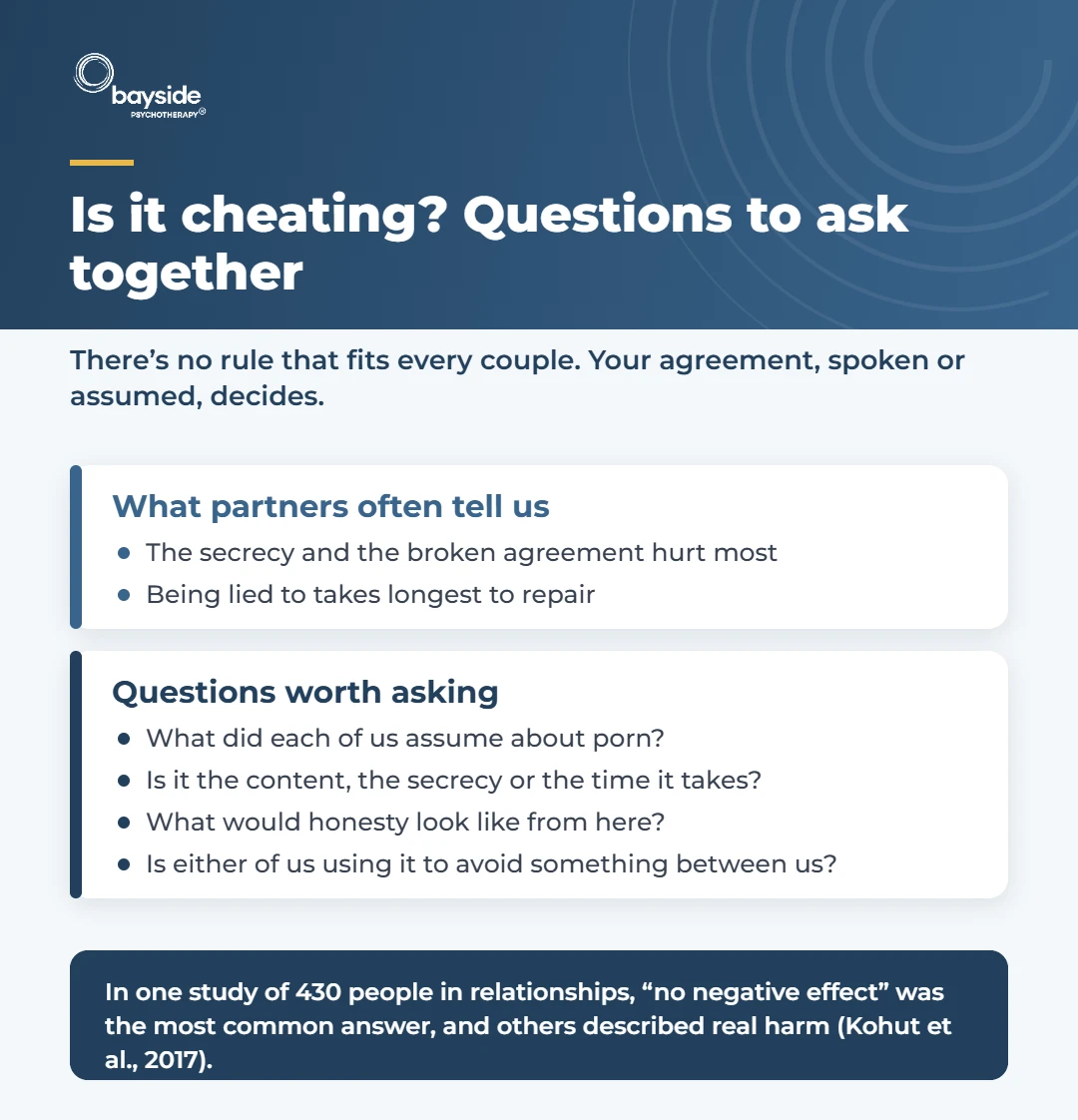
When partners talk with us after finding out, they mostly describe the secrecy and the broken agreement: the hidden history, the deleted searches, the denial when they asked. The content matters to many people too. Still, it is often the sense of being lied to that hurts most, and that takes longest to repair.
What the research says
Research on porn and relationships is mixed. In one study of 430 people in relationships, the most common answer about how porn affected their relationship was that it had no negative effect. Some described benefits, and others described real harm (Kohut and colleagues, 2017). Research can’t settle the question for your relationship. Your agreement can.
Questions worth asking each other
- What did each of us assume about porn?
- Is it the content, the secrecy or the time it takes that bothers us?
- What would honesty look like from here?
- Is either of us using it to avoid something between us?
After it comes out
The partner who was found out often feels relief and wants to move on quickly. The hurt partner may only be starting, and small slips can feel like new evidence for a while. Agreeing to forgive and never mention it again tends to let the hurt return later. Repair usually takes more than one conversation.
How couples can set an agreement
An agreement works best when both people say what they actually want, even if it isn’t what they think the other wants to hear. It can cover whether porn is fine at all, what kind, how often, whether it is private or shared, and what happens if one of you changes your mind.
Some couples agree on no porn. Some agree it’s fine as long as it’s open. What matters is that it’s agreed, that it’s revisited when things change, and that neither of you has to hide anything to keep it.
The first week after finding out
The first days are often the hardest. A few things tend to help:
- Give yourselves time before making big decisions about the relationship.
- Agree when you will talk, and keep those talks shorter than you think they need to be.
- Ask the questions that matter to you, and notice when more detail starts to hurt more than it helps.
- Look after sleep, food and support from someone you trust.
- If you can’t talk without it escalating, that is a good time to get help together.
If you’re the partner who uses porn
Trust usually comes back through what you do over time. In our experience, the things that help most are:
- telling the whole truth once, so new details don’t keep surfacing
- answering questions without getting defensive, even the same question more than once
- being open about devices and accounts for a while, if your partner asks
- keeping the agreement you make, and saying so straight away if you slip
- getting help for yourself if you’ve tried to stop and can’t
A clash of values, or something harder to control?
Sometimes the problem is a difference in values: one partner sees porn as harmless and the other sees it as a betrayal. That is a conversation about the relationship. Sometimes it is a compulsion: the person wants to stop, has promised to stop, and keeps going back anyway. That usually needs individual help as well as conversations as a couple. Many couples are dealing with some of both.
When it might be more than a disagreement
If one of you keeps going back to porn despite wanting to stop, or it is costing sleep, work or your sex life, read about porn addiction. For help talking it through together, see couples counselling ($200 a session, in Highett or online), or use Find your therapist.
Common questions
I found porn on my partner’s phone. What should I do first?
Take a breath before raising it, and choose a time when you can talk without children around or a deadline looming. Say what you found and how you feel, and ask for honesty. It can help to write down what you want to know first.
My partner says porn is normal and I’m overreacting. Am I?
Many people use porn, and many couples are fine with it. That doesn’t decide what is right for your relationship. If something was hidden from you, or it breaks an agreement you thought you had, your hurt makes sense. The useful conversation is about what you each expected.
Can we get past this?
Many couples do, especially when the partner who used porn is honest and the hurt partner has room to be angry for a while. It usually takes more than a few weeks. Couples counselling can help when you keep going in circles.
Should I see someone on my own or as a couple?
Either can help. If the porn use feels out of control, individual sessions help with that side. If hurt and trust are the main issue, couples sessions give you both a place to talk. Some people do both.
Reference
Kohut, T., Fisher, W. A., & Campbell, L. (2017). Perceived effects of pornography on the couple relationship: Initial findings of open-ended, participant-informed, “bottom-up” research. Archives of Sexual Behavior, 46(2), 585–602.