
Many people who book with us already understand their problem well. They can explain where it started, what sets it off and what it costs them. Often they have read the books and tried the apps. Then they do it again, and the gap between knowing and doing becomes the thing that hurts most.
If that sounds familiar, you are in good company. It is one of the most common things people tell us, whether the problem is gambling, porn, drinking, eating, jealousy or avoiding things that make them anxious.
“If only I understood it, I’d feel better”
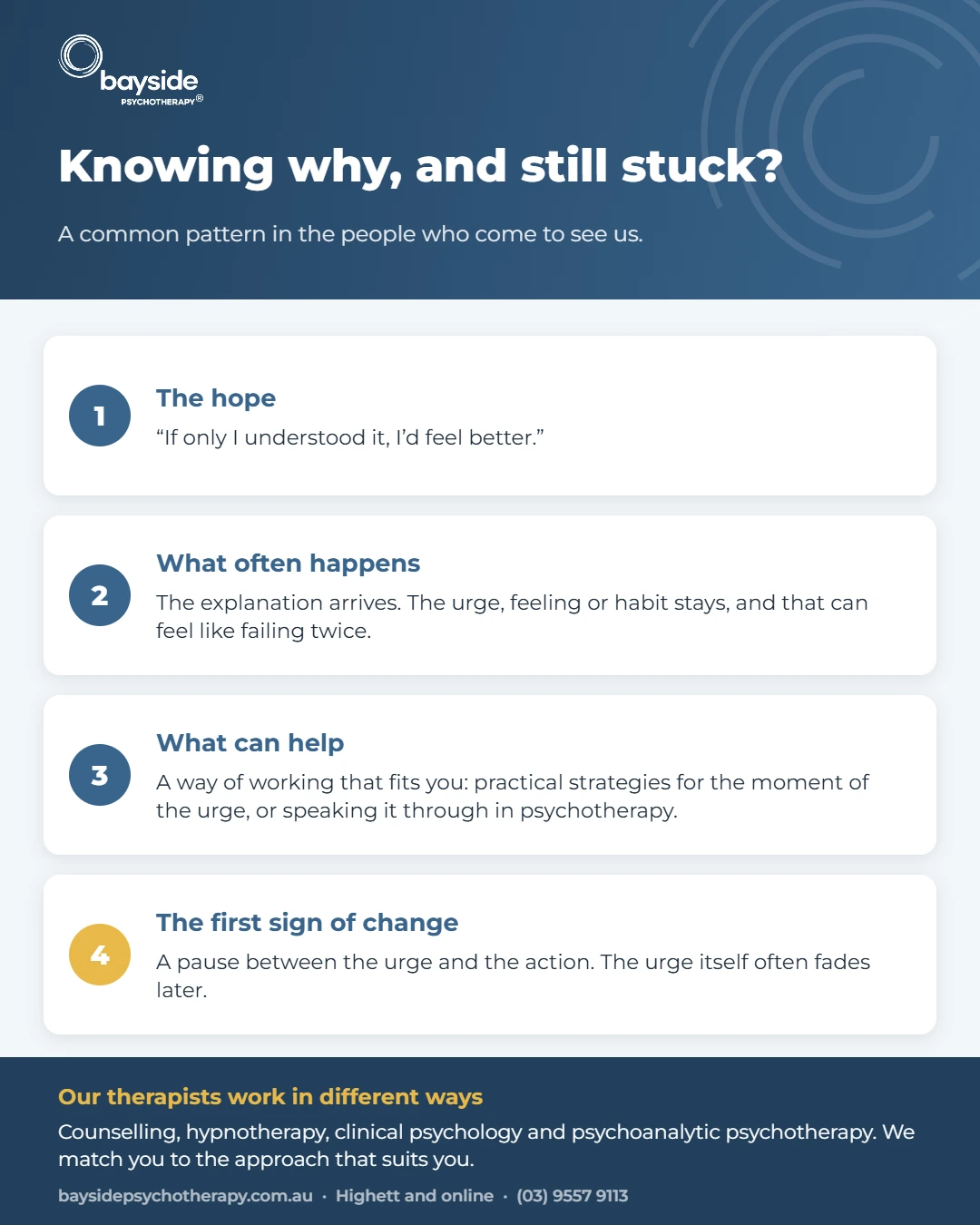
Many people hold on to the hope that if they could only understand their problem, they would feel better. Understanding can bring relief. For many people, though, the suffering carries on after the explanation arrives, and that can feel like a second failure.
Insight lives in the calm moments. Habits run in the heated ones, when an urge, a feeling or a familiar situation takes over faster than reasoning can. Research on the gap between intention and action shows the same thing on a larger scale: a strong change in what people intend leads, on average, to a much smaller change in what they do (Webb and Sheeran, 2006).
Different ways of working, matched to you
Our therapists work in different ways, and part of our job is matching you to the approach that suits you.
Some people want practical help for the moment the urge arrives. Counselling, hypnotherapy and clinical psychology can offer strategies for that moment, and ways to calm the body and mind while the habit loosens.
In psychoanalytic psychotherapy, change comes through the act of speaking itself. Speaking freely, in your own words and in a way unlike everyday conversation, lets things surface that careful thinking keeps tidy. Over time, what you hear yourself say can shift a pattern that years of thinking about it had left in place.
If you are unsure which way of working suits you, Find your therapist asks a few short questions, and reception can help you choose.
What tends to change first
In our experience, the first shift is usually a little more room between the urge and the action: a pause, a choice, a different response. The urge itself often fades later, once it stops being obeyed every time.
Why being hard on yourself backfires
Many people treat self-criticism as a way of taking responsibility. Yet harsh self-punishment tends to bring shame, and shame tends to bring hiding and low mood, which are often the very conditions the habit grows in. Responsibility that looks forward, to what you can put right or do differently next time, is usually more useful.
When the habit moves somewhere else
Blocking an app or giving up one thing can buy valuable time. Sometimes, though, the urge turns up somewhere new: another app, a different substance, compulsive exercise or spending. When that happens, it is a sign the habit was doing a job, and the job still needs attention.
When to get help
It is worth talking to someone when you have tried more than once on your own, when the habit is costing you money, sleep, work or a relationship, or when the shame afterwards is getting heavier. You don’t need to know exactly what is wrong before you book. Working that out is part of the first session.
We see people in Highett and online. Read more about gambling, porn addiction, binge eating, internet addiction and addiction counselling, or find your therapist.
Common questions
If understanding doesn’t fix it, why talk about it at all?
Talking in therapy does more than explain. In psychoanalytic psychotherapy, speaking freely, in your own words, lets things surface that careful thinking keeps tidy, and over time that can shift a pattern. Other approaches use talking to plan and practise new responses for the moment the urge arrives.
How long does it take for things to change?
It depends on the person, the habit and what it is doing for them, so no one can give you a set number of sessions. Many people notice the first shift as a little more room between the urge and the action, before the urge itself fades.
Is it a lack of willpower?
Usually it isn’t. Most people we see have tried hard on their own, often many times. Habits run fast, in heated moments, and willpower tends to be weakest exactly then. That is a reason to change the approach, and it says little about your character.
Should I stop trying to understand why?
Understanding helps, and it often makes the rest of the work easier. It tends to be one part of change, alongside what happens in the moment of the urge and in your relationships.
Reference
Webb, T. L., & Sheeran, P. (2006). Does changing behavioral intentions engender behavior change? A meta-analysis of the experimental evidence. Psychological Bulletin, 132(2), 249–268.