Our therapists see people for anxiety, addictions, relationships, eating, mood and more. Over time, some patterns come up again and again. This page shares the ones we see most clearly, so you can check whether they fit your situation.
Last updated . Written and reviewed for accuracy by Adam Szmerling.Accredited Mental Health Social Worker (AASW), PACFA Registered Clinical Psychotherapist
These patterns come from de-identified summaries of sessions, read across many clients and reviewed by Adam Szmerling. They describe people who came to us for help, so they aren’t facts about everyone, and no individual’s story is told here.
Knowing why rarely stops it on its own
Many people arrive already understanding their problem, and hoping that understanding will make them feel better. Often the explanation arrives and the suffering stays. Change usually shows first as a pause before the urge or reaction, with the urge itself fading later.
“Therapy didn’t work” often means the wrong kind of help
When earlier therapy disappointed, people often wanted something different from what they got: tools when they were offered talk, or depth when they were offered worksheets. Our therapists work in different ways, and we match you to the one that suits what you need.
In couples, the partner who goes quiet usually describes overwhelm. The other experiences the silence as being shut out. A pause with a time to return lands better than open-ended silence.
After a secret comes out, partners move at different speeds
The person who told often feels relief and wants to move on. The hurt partner may only be starting, and small slips can feel like new evidence for a while.
A diagnosis can bring real relief, open the door to the right treatment and help people feel less alone, and conditions such as ADHD deserve proper assessment and care. In our experience, people sometimes hope that a label, a new relationship or the right medication will settle everything. Often it helps with part of the picture, and the rest still needs attention. Therapy can sit alongside a diagnosis or medication, and we’ll suggest your GP or a psychiatrist where that fits.
Why a first session matters, even after matching
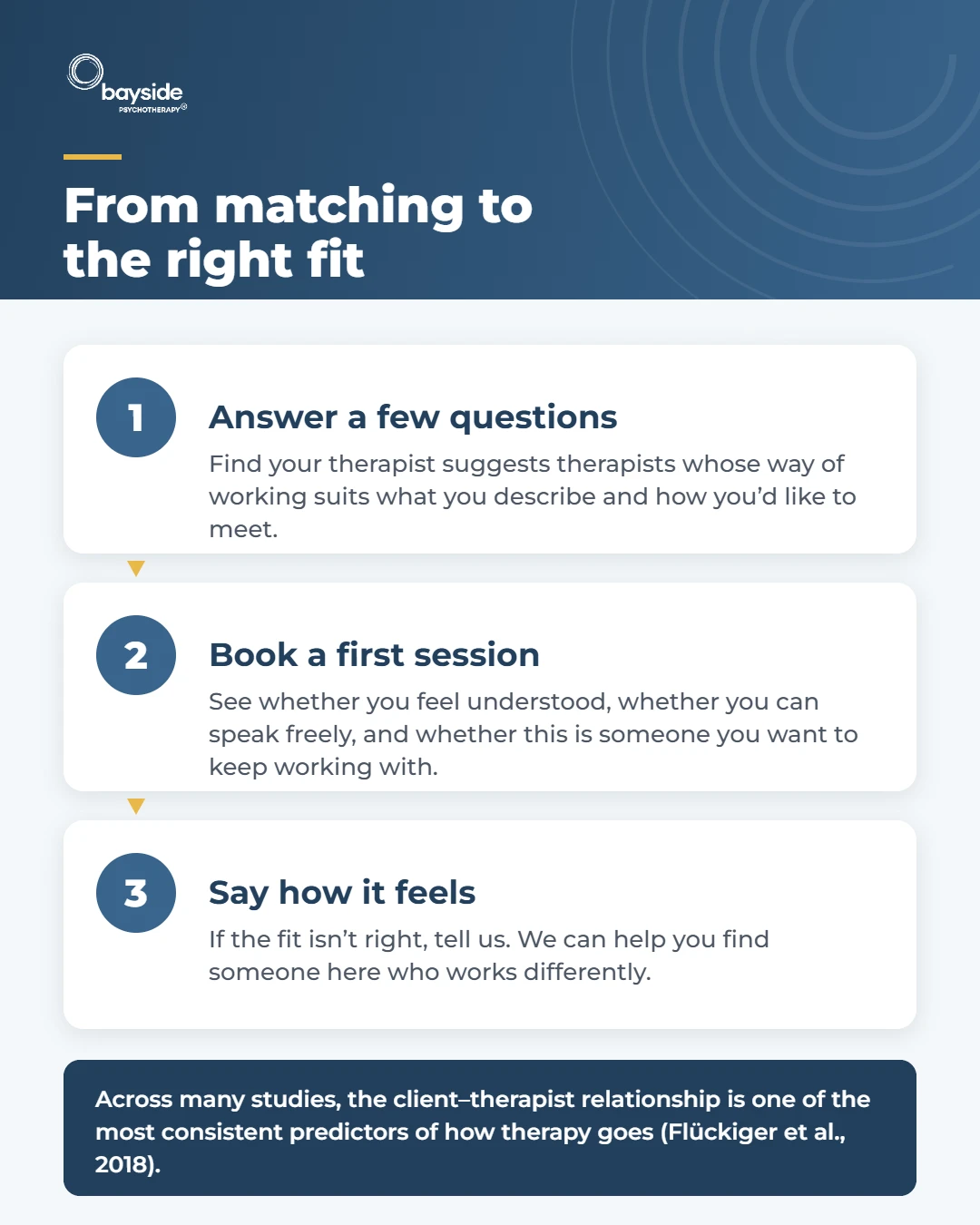
Our Find your therapist questions are a good starting point. They point you to therapists whose way of working suits what you describe. A first session then tells you something no questionnaire can: whether you feel understood, whether you can speak freely, and whether this is someone you want to keep working with. It is worth booking that first session with an open mind, and saying so if the fit doesn’t feel right.
Research across many studies finds that the working relationship between client and therapist is one of the most consistent predictors of how therapy goes, across very different methods (Flückiger and colleagues, 2018). In our experience too, the relationship carries the work. The method matters, and it works best inside a relationship where you feel safe enough to say what you really think. If the fit isn’t there, we can help you find someone else here who works differently.
We use these patterns to make our pages more useful and to shape how we explain therapy. They don’t replace research, and where research exists we cite it on the relevant page. Your own situation is always assessed on its own terms in your first session. See also how we check our content.
Reference
Flückiger, C., Del Re, A. C., Wampold, B. E., & Horvath, A. O. (2018). The alliance in adult psychotherapy: A meta-analytic synthesis. Psychotherapy, 55(4), 316–340.