

You know the truth. And you know that deep intimacy and self-esteem are impossible without it. So how did the occasional ‘little white lie’ become a habit, a strategy?
More importantly, how do you turn it around? How do you stop compulsive lying, regain your sense of self-worth, and return to a life of trusting, secure relationships?
The first step in recovering from compulsive lying (also known as ‘pathological lying’) is to understand it. To get to the bottom of why you do it.
Compulsive lying usually starts during childhood. Often as a way of coping with difficult feelings of shame or anxiety, or in response to growing up in an emotionally unsafe environment (where certain thoughts and feelings are considered 'wrong').
Eventually the lying becomes an effective way of avoiding difficulties. In many cases, compulsive liars believe, deep down, that their true self is deeply flawed and “not good enough”. They feel they need to lie to win the acceptance of people they value.
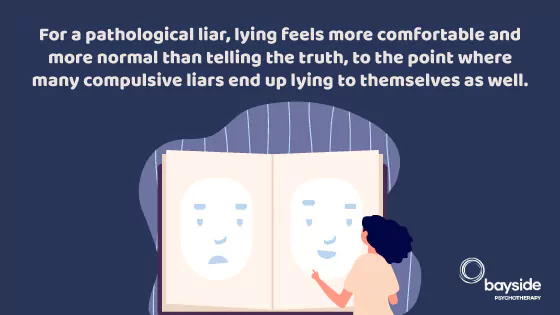
Over time, lying becomes addictive. A habit. It feels more comfortable and more normal than telling the truth, to the point where many compulsive liars end up lying to themselves too.
Unfortunately, without treatment, it can last a lifetime.
While lying may have seemed to make life easier in the past, you’ve probably already realised it can have a significant negative impact on your loved ones, friends and colleagues. Even on strangers! It can ruin your career and destroy relationships.
Deep intimacy requires trust. Friendships require trust. Fruitful working relationships require trust. Without trust, everything you say is called into question and every important person in your life feels constantly betrayed.
Just as importantly, your compulsive lying may also be preventing you from getting what you need from your relationships. Instead of expressing what you want, and addressing issues, many compulsive liars are chronic ‘people-pleasers’ who bury resentment. Their partners, friends and colleagues don’t even know they’re unhappy, so there’s virtually no chance of improvement.
Plus there’s the constant anxiety about getting caught in a lie. The pressure to ‘remember your lies’ and to manage the snowball effect of covering up lies with lies, leads you to feel guilty, fake, worthless and powerless to change.
But it doesn’t have to be this way. You can stop compulsive lying.
Admitting that you have a problem with compulsive lying is the first, courageous step in overcoming your lying problem. Treatment is the second.
Our psychotherapy, counselling or hypnotherapy services will help you identify and address the underlying causes of your compulsive lying, and, before too long, stop lying altogether.
As you begin to overcome the causes and resultant habits of compulsive or pathological lying, you may notice an improvement in your relationships and a significant increase in your self-confidence. Not the fake kind of confidence that lying temporarily provides, but an authentic feeling of self-worth.
We offer counselling services in Melbourne, or online counselling via Skype. And both are completely non-judgemental. It’s a safe, supportive, accepting environment, and we don’t force you to endure excess guilt. It’s not something you should feel ashamed of, or try to hide. It’s merely something that needs treatment — ideally from someone who has no emotional involvement, and can offer a completely objective and informed perspective.
Just as importantly, we don’t just treat your symptoms; we help you discover the cause of your compulsive lying, so you can live a more satisfying, fulfilling and authentic life.
During your first visit, you'll be able to discuss your problem in confidence, ask any questions, and decide if your psychotherapist is the right ‘fit’ for you. This initial session will give us an insight into the issues involved in your pathological lying, and help us understand what you want to achieve.
After the first session, we’ll begin tailoring a treatment plan to your individual needs. It’s possible we may be able to manage your compulsive lying by changing your habitual thoughts and responses, through hypnotherapy, but usually longer term treatment involving psychoanalytic psychotherapy is required. (Psychoanalytic psychotherapy is an insight-oriented, intensive treatment that requires an honest commitment from you to addressing issues, but it is very effective for resolving the underlying causes of compulsive or pathological lying.)
That’s not to say that psychoanalytic psychotherapy, alone, is always the answer to compulsive lying. Every case is different. Yours may require a combination of psychoanalytic psychotherapy and proven ‘natural’ treatments like Buddhist psychotherapy, Mindfulness Therapy and Attachment Therapy. Our counsellors are qualified in a range of counselling approaches and treatment techniques, so they’re able to tailor a plan to your specific needs and preferences, rather than trying to force an approach that doesn’t quite work for you.
For some people, treatment starts working within the first few sessions. However almost everyone requires longer term psychotherapy. Although you may begin to experience change quite quickly, our treatment is not a quick-fix or ‘band-aid’ solution.
We’re committed to overcoming your compulsive lying, but you need to be committed too. Your progress relies, fundamentally, on your attitude and participation in therapy, so you must be open to treatment.
Call Bayside Psychotherapy on (03) 9530 6353 (Melbourne) or use our contact form to find out if we can help you overcome your compulsive lying or pathological lying. Your call is completely confidential, and there's absolutely no obligation.