

Emetophobia · Fear of vomiting
Emetophobia Treatment in Melbourne & Online
Does the thought of being sick, or of being near someone who is, shape your whole day? You are not alone, and it can be treated. Our therapists work with emetophobia in Highett, Melbourne, and online anywhere in Australia.
Clinically reviewed by Adam Szmerling, Accredited Mental Health Social Worker (AASW) and Clinical Psychotherapist (PACFA). Last reviewed 19/09/2026.
Checking availability…
What is emetophobia?
Emetophobia is an intense, persistent fear of vomiting, or of seeing and hearing others vomit. It is classed as a specific phobia in the DSM-5-TR. It often starts in childhood, affects far more women than men, and leads people to avoid foods, travel and anyone who might be unwell.
How is emetophobia treated?
The best-supported treatment is cognitive behavioural therapy with graded exposure (however every treatment is individualised and client centred at Bayside). You gradually face the situations, sensations and thoughts you avoid, and drop the safety behaviours that keep the fear going. In the first randomised trial, half of the people who had 12 sessions of CBT made clinically meaningful change.
Therapists who treat emetophobia
Each of our practitioners works with emetophobia in a different way. Compare their approaches in the table further down this page, or use our therapist matching tool if you are not sure where to start.

Adam Szmerling
Psychoanalytic Psychotherapist
20+ years’ psychoanalytic expertise guiding individuals and couples through anxiety, addictions, and relationship struggles to lasting calm.

- 20+ years of experience
- $200 per 50-min session
 Rebate with a valid MHCP
- Available in-person & online
Checking availability…


Start Your Therapy Journey Today. Choose Online or In-Clinic Above

Carolina Rosa
Counsellor & Hypnotherapist
Featured on House of Wellness, helping people overcome anxiety and self-doubt with lived experience and tools for lasting change.
- 15+ years of experience
- $170 per 50-min session (Individuals)
- Available in-person & online
Checking availability…
Start Your Therapy Journey Today. Choose Online or In-Clinic Above

Bernadette Cameron
Hypnotherapist, Counsellor, NLP Master Practitioner
Registered counsellor with a Certificate IV in Clinical Hypnotherapy, supporting adults with anxiety, depression, trauma and relationship challenges.
- 5+ years of experience
- $170-$200 per 50-min session
- Available in-person & online
Checking availability…
Start Your Therapy Journey Today. Choose Online or In-Clinic Above

Sara Herring
Clinical Hypnotherapist and Counsellor, Melbourne
A clinical hypnotherapist trained at the Academy of Hypnotic Science, helps people overcome anxiety, addictions and habits, without judgement.
- 20+ years of experience
- $170 per 50-min session
- Available online
Checking availability…
Start Your Therapy Journey Today. Choose Online or In-Clinic Above

Humaira Ansari
Hypnotherapist, NLP Practitioner, Psychotherapist and Counsellor
Experienced Master Hypnotherapist, experienced in hypnotherapeutic, neuro-linguistic, psychotherapeutic techniques.
- 16 years of experience
- $170-$200 per 50-min session
- Available online
Checking availability…
Start Your Therapy Journey Today. Choose Online or In-Clinic Above
Lawrence Akers
Hypnotherapist & Counsellor
Clinical Hypnotherapist using ACT, CBT, and mindfulness to support lasting change, with deep experience in LGBTQIA+ wellbeing.
- 10 years of experience
- $170 per 50-min session
- Available in-person & online
Checking availability…
Start Your Therapy Journey Today. Choose Online or In-Clinic Above
Here’s something many people with emetophobia never hear: it is the most common type of specific phobia that people seek treatment for.
At Bayside Psychotherapy, featured on Channel 7’s House of Wellness, we see how much this fear can shrink everyday life, from meals and travel to work and relationships. We also see how much can change with the right help.
Our therapists offer psychotherapy, counselling and hypnotherapy in Highett, in Melbourne’s bayside suburb, or online anywhere in Australia. You don’t have to face this alone.
Get matched with a therapist:
What Is Emetophobia?
Emetophobia (also called specific phobia of vomiting, SPOV, or vomit phobia) is an intense fear of vomiting. It is one of the specific phobias. For about half of people the fear centres on being sick themselves. For others it is seeing someone else vomit, or both, according to a 2025 meta-analysis. The fear is out of proportion to the actual risk, it has usually been around for years, and it shapes daily decisions – what to eat, where to go and who to be near.
How is emetophobia diagnosed?
The DSM-5-TR does not list emetophobia by name. Clinicians diagnose it as a specific phobia (other type) when:
- the fear of vomiting is marked and is triggered almost every time by the same cues
- you actively avoid those cues, or get through them with intense anxiety
- the fear is out of proportion to the actual danger
- it has lasted six months or more
- it causes significant distress or gets in the way of work, study, relationships or eating
- another condition, such as OCD or an eating disorder, does not explain it better
How common is emetophobia?
A 2025 meta-analysis of 31 reports estimated that about 5% of people have emetophobia, although estimates varied widely between studies. Around 91% of people affected are women, and the average age it starts is about 10. Many people wait years before asking for help, often because the fear feels embarrassing to talk about.
How we treat emetophobia at Bayside Psychotherapy
There is no one-size-fits-all approach. Our practitioners use different methods, and the right fit depends on what your fear looks like and what you want from therapy.
CBT-informed graded exposure
Best for: fear driven mainly by avoidance and safety behaviours.
Exposure-based therapy has the strongest research support for specific phobias. For emetophobia it usually involves:
- building a step-by-step “fear ladder” together, starting well below anything close to vomiting
- testing predictions with small experiments (for example, “If I eat at a restaurant, I will be sick”)
- gradually dropping safety behaviours such as checking and avoiding
- in some cases, imagery rescripting, which works on vivid early memories of vomiting
An updated 2026 treatment protocol describes roughly 8 to 20 hours of therapy, depending on severity.
Practitioners: Carolina Rosa and Lawrence Akers (CBT and ACT-informed).
Psychoanalytic psychotherapy
Best for: fear that sits alongside wider anxiety, relationship patterns or a history you want to understand.
Psychoanalytic psychotherapy looks at what the fear of vomiting means for you: themes of control, disgust and safety, and how earlier experiences shape them. Sessions are less structured than CBT. You talk freely, and the work follows what emerges. Research on specific treatments for emetophobia is still limited, so this suits people who want depth work, often alongside practical goals for reducing avoidance.
Practitioner: Adam Szmerling. Medicare rebates may apply with a Mental Health Treatment Plan.
Clinical hypnotherapy
Best for: a strong physical panic response, or wanting support to rehearse feared situations.
Clinical hypnotherapy uses focused, relaxed attention to calm the body’s anxiety response and to rehearse feared situations in your imagination. Some practitioners combine it with exposure principles, an approach described in a 2025 case report. The research on hypnotherapy for emetophobia is still small, so we use it as one part of a broader plan rather than as a stand-alone cure.
Practitioners: Carolina Rosa, Sara Herring, Lawrence Akers, Humaira Ansari and Bernadette Cameron.
Between sessions, our emetophobia self-hypnosis recording can be a useful practice tool.
Which approach is right for me?
| If you… | Consider | Practitioners |
|---|---|---|
| want a structured plan with practice between sessions | CBT-informed graded exposure | Carolina Rosa, Lawrence Akers |
| want to understand where the fear comes from and how it links to the rest of your life | Psychoanalytic psychotherapy | Adam Szmerling |
| feel your body’s panic response is the biggest barrier | Clinical hypnotherapy alongside other work | Carolina Rosa, Sara Herring, Lawrence Akers, Humaira Ansari, Bernadette Cameron |
| want a Medicare rebate | Psychoanalytic psychotherapy with a Mental Health Treatment Plan | Adam Szmerling |
What causes emetophobia?
There is rarely a single cause, according to a systematic review of the research. Common starting points include:
- a frightening experience of vomiting, or of seeing someone else be sick, often in childhood
- a severe bout of gastro, food poisoning or motion sickness
- a general tendency towards anxiety
Some people cannot recall a trigger at all. Whatever started it, the same cycle of avoidance tends to keep it going, and the same approaches can help.

Is it emetophobia, OCD, anxiety or an eating problem?
Emetophobia overlaps with several other conditions, which is one reason it is often missed:- OCD: checking, hand washing and reassurance seeking can look like contamination OCD.
- Panic and health anxiety: nausea is a common symptom of anxiety itself, so the fear can feed on its own sensations. See our pages on health anxiety and generalised anxiety.
- Avoidant/restrictive food intake disorder (ARFID): in a 2025 study of adults with emetophobia, 48% met self-reported criteria for ARFID.
The conditions that most often occur alongside emetophobia are social anxiety, depression and generalised anxiety. A careful first assessment helps us understand what is driving your symptoms and which approach suits you.
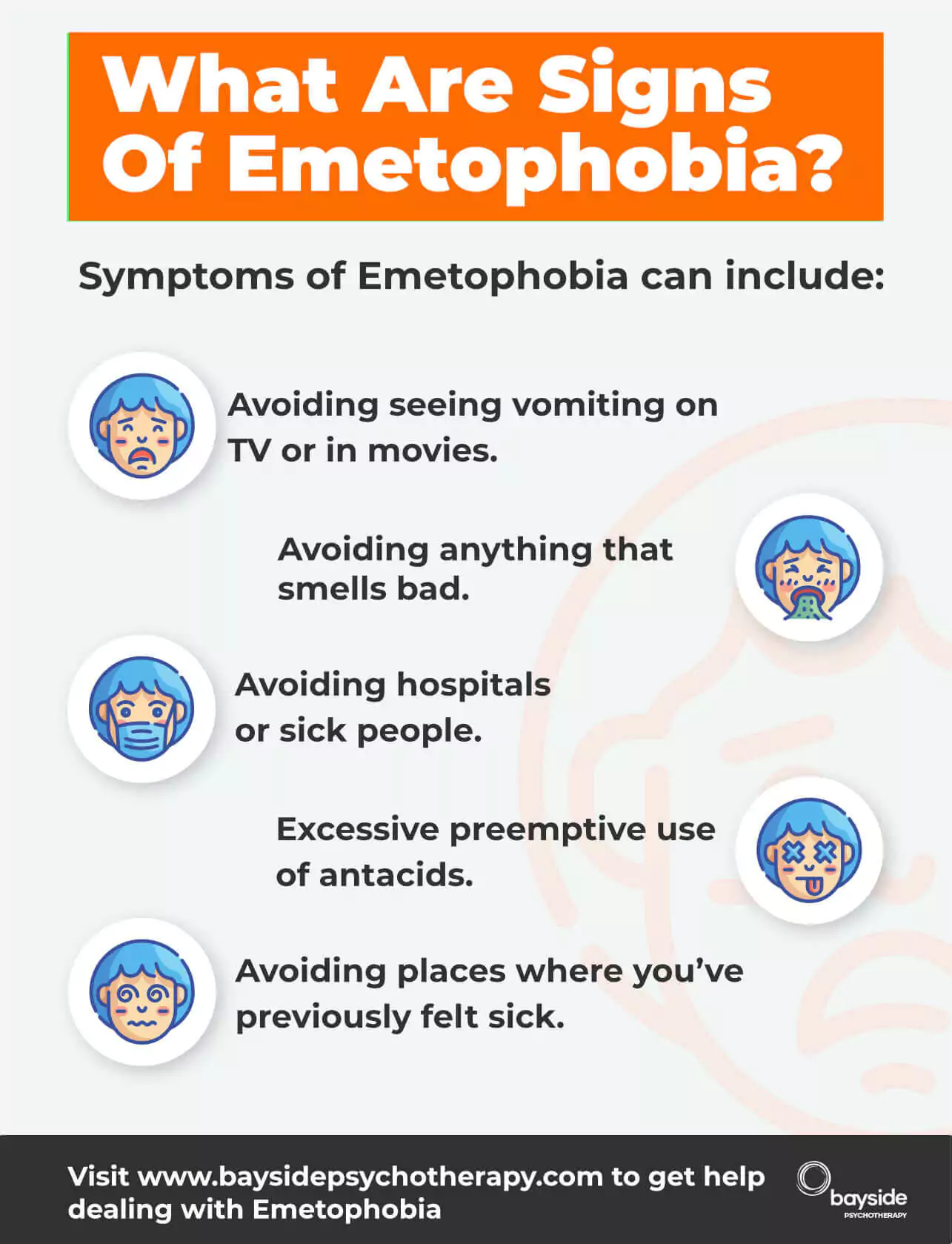
Signs and symptoms of emetophobia - Signs at a glance: Common signs include panic at the thought of being sick, constantly checking your stomach, avoiding foods, alcohol, travel or unwell people, checking use-by dates, excessive hand washing and seeking reassurance. When these habits start shaping your meals, work or relationships, it may be emetophobia.
What it feels like
- Intense anxiety or panic at the thought of vomiting, or when you feel slightly nauseous
- Constantly monitoring your stomach for signs of sickness
- Distress at the word “vomit”, or at seeing vomiting on TV
- Worry that builds for days before meals out, travel or social events
What people avoid
- Foods seen as “risky”, such as chicken, seafood, leftovers or eating out
- Alcohol, public transport, planes, boats and theme parks
- Hospitals, schools, young children and anyone who might be unwell
- Places where you, or someone else, once felt sick
Safety behaviours
- Checking use-by dates, over-cooking food or eating very small amounts
- Excessive hand washing or sanitising
- Carrying mints, antacids or anti-nausea tablets “just in case”
- Sitting near exits or bathrooms, and asking others for reassurance that you won’t be sick
Now, take a minute to reflect. If several of these are part of your week, emetophobia may be shaping more of your life than you realise. The good news is that it responds to the right help.
Why does the fear stick?
Every time you avoid a food or check a date, your anxiety drops a little. Your brain learns that the safety behaviour “worked”, so the fear never gets tested, and the list of things to avoid slowly grows.
To put it simply, the things you do to stay safe are what keep the fear alive. Treatment works by gently loosening that cycle, one step at a time.
When to see your GP first
Please see your GP if you have ongoing nausea, reflux or stomach pain, have lost weight without trying, or are eating much less than usual. They can rule out a physical cause and, if you are eligible, prepare a Mental Health Treatment Plan if you see Adam Szmerling. If restricting food is a big part of the picture, the Butterfly Foundation helpline (1800 33 4673) can also help.
What happens when you start therapy?

Yes. A 2025 meta-analysis pooling over thirty studies estimated it affects around one in twenty people, with women making up roughly nine out of ten cases. Because it can feel embarrassing to describe, many people live with it for years before mentioning it to anyone, including their GP.
There's no single cause. It often follows a specific frightening episode, such as vomiting in public or a severe stomach bug, though it can also build up gradually with no clear trigger, particularly in people who already lean anxious. Both patterns respond to the same treatment approaches.
It can be treated. Exposure based therapy, where you gradually and safely face the situations you avoid, has the strongest evidence for specific phobias including emetophobia. Most people who complete a course of treatment see a real drop in fear and avoidance, not just better coping strategies.
No. Exposure work is built up in small, agreed steps. You and your therapist plan out a hierarchy of feared situations together and only move to the next one once you're ready, usually starting well below anything close to real vomiting.
A Medicare rebate may apply if your GP issues a Mental Health Care Plan and you see a practitioner registered to provide rebated sessions. At Bayside Psychotherapy, Adam Szmerling, a psychotherapist and accredited mental health social worker, currently offers Medicare rebated sessions for eligible clients seeking a depth approach (talk therapy). Speak with your GP or our team to check what applies to you.
Yes. Both psychotherapy and hypnotherapy for phobias translate well to secure video sessions, and outcomes for telehealth phobia treatment are generally comparable to in person, Melbourne sessions for most clients.
It can. Hypnotherapy is often used alongside other psychotherapy or exposure based work to bring down the physical anxiety response, which makes the rest of treatment easier to engage with. The research on hypnotherapy alone is thinner than for exposure based approaches, so most therapists use it as one part of a broader plan rather than the whole treatment.
Ready to stop the fear running your life?
Book a session in Highett, Melbourne or online, or call us on (03) 9557 9113. Your call is confidential and there is no obligation.
You can book an online appointment or an in-clinic session directly.
This page is general information, not individual clinical advice. Outcomes vary from person to person, and no result can be guaranteed. If you are losing weight, avoiding eating or worried about your physical health, please also see your GP.