
Counselling, Psychotherapy and Talking to a Friend

Counselling, Psychotherapy, Therapy No Comments »

This is an important topic. So many people rightfully wonder, what is in fact the difference between having a heart to heart with a close friend, or speaking to a professional
psychotherapist or counsellor. Really, this is so important, in fact, that the topic just can’t be overstated or overdone.

Firstly, many clients initially assume that professional counselling and psychotherapy is just talking. And how can they be expected to know any different? But the reality is, a
professional psychotherapist and counsellor will spend a lot of time thinking about the person, and will be informed by therapeutic expertise and experience in light of the presenting issue and past history of the client.

Furthermore, with professional counsellor, for example if you were to obtain counselling in Brighton or Melbourne counselling, you can reasonably expect to get a lot more than you would with a close friend. Although they may try to be objective, a close friend acting as therapists, is actually creating a dual relationship with you in which friendship boundaries and therapy boundaries become blurred. This can significantly compromise the friendship in later years, and render you more vulnerable and unhappy.

Similarly, an ethical psychotherapist or counsellor would never enter into a friendship relationship with the client. This enables the professional relationship to be safe, secure and unconditionally accepting without any threat of ruining the relationship. Whilst there is a monetary component to professional therapy, the experience must be emotionally unconditional. A professional counsellor and psychotherapist can offer a significantly containing corrective emotional experience for individuals suffering troubled behaviours and difficult emotional experiences.

If you are seeking professional help of counselling in Brighton or counselling in Melbourne with an insight oriented psychotherapist, help is available.

How To Stop Cannabis Addiction

Counselling, Hypnotherapy, Psychotherapy, Therapy No Comments »

Marijuana addiction or cannabis addiction is common, but can become extremely debilitating for users and their partners and families etc. Cannabis is a toxic substance and especially these days involves often non pure and potentially more dangerous chemicals being mixed in even from so-called trusted sources.

Cannabis use can contribute to paranoia, distorted view of self and others, and even anxiety disorders and depression. Long-term use could even lead to psychosis of schizophrenia.

Cannabis also has the influence of distorting short-term memory and distorting one’s view of reality at which time apathy may settle in and after a session people may decide to quit, but feel very guilty. This guilt, although possibly understandable frequently cements the problem even deeper.

Fortunately, there is a different solution to banging ones head against the wall and continuing the cycle of drug use and guilt, loss of confidence etc.

It’s not so much the approach as it is the combination of approaches that can be very effective to stop cannabis addiction.

More specifically, the combined mindfulness therapy and counselling and hypnotherapy series of interventions can be markedly beneficial for individuals suffering cannabis addiction. In fact, it could be easier than you think. In addiction, getting a structured routine, and building positive activities into structured days can help too.

That doesn’t mean it’s easy, but it’s a lot easier than trying to do it all by yourself or worse, with willpower alone. A secure therapeutic counselling relationship can help replace the need, or more accurately the perceived need, to use marijuana.

In Brighton Melbourne or online via Skype, counselling services are available, as well as hypnotherapy and mindfulness therapy services to help you take back control of your life.

Addictions Can Be Overcome

Counselling, Hypnotherapy, Psychotherapy, Therapy 2 Comments »

That’s right. The liberating sense of freedom and feelings of confidence that arise from stopping addictive behaviour can bring renewed self worth and a joyful life. Not in some passing self-help fleeting kind of way, but in a genuine feeling of this is how life is meant to feel way.

Addictions arise in many guises. There are countless addictions. Addictions to sex, materialism, drugs, gambling, body image, and countless other general addictions plague our materialistic, narcissistic society. Cultural influences aside, we all have our own reasons for struggling with various vices.

Addictions are misguided attempts to regulate and manage how we feel. More specifically, they usually developed as an attempt to avoid feeling something. Be that the depression, anxiety, or countless other troubles, avoidance feeling always leads to feeling worse than the intended avoided behaviour.

Addictions are our replacement attempts to mask and deal with our earlier childhood attachment needs. And it is to feel in control, secure and held. Many people with serious addictive behaviours struggle to develop genuinely felt connections and intimate relationships with other human beings.

That is why, 12 step programs have a lot of value to many addictive behaviours. Individual psychotherapy and Buddhist psychotherapy in particular, coupled with hypnotherapy and various counselling approaches with one therapist can actually help addicted people to develop healthy dependency needs and reduce and eliminate their maladaptive addictions.

If you live in the Brighton, Melbourne, area I can help you overcome addictions if you are ready and willing to work through your issues. Or if you can’t get to brighton, we can have online counselling sessions via Skype.

Stop Specific Phobia From Running Your Life

Counselling, Hypnotherapy, Psychotherapy, Therapy No Comments »

There are hundreds of specific phobias. Phobias are amongst the most intensive anxiety disorders. But because they are so specific, i.e., that you don’t ever forget to have a phobia, for example when you’re confronted with a spider or even the thought of a spider (if for example you have arachnophobia).

Until you live with a phobia, and it’s very difficult to appreciate just how debilitating and terrifying specific phobia can be on an individual’s quality of life.

This suggests that you are remarkable learner. But also probably have an overactive imagination when it comes to your specific phobia. Don’t feel foolish. Phobias are extremely common, and often developed during childhood and get worse as we get older when left untreated.

But because specific phobias are so obviously present, such as when your heart pounds and you feel so powerless and terrorised, it is rather clear to people and their therapists when change occurs. In other words, specific phobia treatment is a lot less complicated in most cases than say, treatment of general anxiety disorder or major depressive illness.

Whilst are so many different forms of counselling, psychotherapy, NLP, hypnotherapy, a meditation exercises, the best approach is the one that is tailored to combust works to you as an individual.

In Brighton Melbourne counselling and hypnotherapy and NLP are available treatments for specific phobias. Self hypnosis recordings are also recommended to help manage feelings between sessions. A specific phobia can be dealt with rather quickly comparatively, with the right blend of counselling and hypnotherapy with a season therapist.

Counselling, Hypnotherapy And Change Versus Not Change

Counselling, Hypnotherapy, Psychotherapy, Therapy 2 Comments »

Change versus not change. On the surface, it doesn’t seem like a very interesting question. But when you contemplate the various psychological philosophies, of Buddhism and Western psychotherapy, striking differences seem to occur.

Buddhist psychotherapy, which partly incorporates mindfulness therapy, is all about not change. In other words, it is about developing self acceptance, and enhanced self-awareness, through nonjudgemental moment by moment tracking of internal and external experience in the present moment, without an express intention to change. It is further elaborated within this framework, that, our intense yearning for change, or in other words not wanting things to be as they are, are precisely what leads to suffering in the first place.

More traditional forms of Western psychological counselling approaches and hypnotherapy, stressed the importance of the opposite philosophy, namely, achievement and change at all costs. On this extreme, we can see a narcissistic preoccupation with change, like a rabbit hole or a rat race, or a bottomless bucket that can never be filled. That’s right. An endless loop of chasing one’s tail or trying to quench an impossible thirst but always getting thirstier and thirstier in the process.

As you might have guessed, one approach is no better or worse than the other. Both have a lot to offer and both have possible limitations. An integrated balance is crucial. When you choose a counsellor, psychotherapist or hypnotherapist, make sure that they are trained and experienced in a discipline which meets with your broader philosophical worldview regarding how change will occur for you. Then again, if you are extremely outcome driven in your life, and find it difficult to just be, you may benefit from a more contemplative and relaxed approach, such as Buddhist psychotherapy of mindfulness therapy which cultivates self acceptance and trains you to be a human being, rather than a human doing.

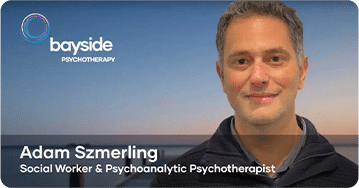
Melbourne’s Adam Szmerling works out of Brighton and is trained in both Buddhist psychotherapy, and Western forms of counselling. He is also a trained hypnotherapist in both Ericksonian and traditional methodologies. He integrates the best of East and West to provide his valued clients with whatever they need in collaboration with him., whether that be change, self- acceptance or both.

Mindfulness Meditation, Hypnotherapy, Counselling And Psychotherapy

Counselling, Hypnotherapy, Psychotherapy, Therapy, Uncategorized 2 Comments »

Therapy works. It’s been known for years. Nobody really knows how, although many think they change occurs because of the method or approach. The only thing that is certain, is that of the 400 odd methods of counselling, psychotherapy, and hypnotherapy, that they do help people most of the time.

What is fascinating, however, is that meditation and yoga, and more recently and specifically, mindfulness-based approaches to meditation, have begun to seep their way into the psychotherapeutic arena.

Mindfulness meditation is a lot more than just sitting down like a Buddha, although mindfulness did originally derive from Buddhist psychology and philosophy. Mindfulness-based counselling approaches involve moment to moment intentional awareness to present moment experience of thoughts, feelings, body sensations, behaviours, relationships, and any other here and now experience without any form of criticism or judgement. This does not mean, that judgements do not arise later, but when they do, they usually are a lot more sound and clear than they would otherwise be.

Commonly however, a mindful stance is not the same thing as a directive approach, say cognitive behavioural therapy. This is true. But mindfulness approaches can be integrated with hypnotherapy, for example in an altered state of consciousness ie. trance, encouragement for people to become more mindful of their own internal unconscious phenomena and experience, which can be materialised.

Counselling and psychotherapy can also be either direct or nondirective. If one wishes to apply the 2500+ years of wisdom from Buddhist psychology, or mindfulness-based meditation, to psychotherapy, one needs a deep appreciation both in experience and in theory of Buddhist psychological practices in mindfulness, as well as Western psychotherapeutic understandings.

Thus, in integration becomes possible. With integration patients have a much wider potential for self realisation and overcoming suffering. Buddhist psychotherapist Adam Szmerling practices counselling in Brighton Melbourne. He also practices hypnotherapy. He blends hypnotherapy, psychotherapy, counselling, and mindfulness therapy uniquely for the aim of assisting his patients to overcome suffering.

How To Stop Addictions

Counselling, Hypnotherapy, Psychotherapy, Therapy No Comments »

Addictions come in many forms. Drug addictions, shopping addictions, sex addictions, gambling, and countless other compulsions plague our society. You name it. If there’s a name for it, someone somewhere is probably addicted to it.

Problem? Absolutely! Why? Because an addiction is a symptomatic trance, or an attempt to feel different, but without a real relationship or real human connection.

This is why 12 step programs and group therapy can work extremely well to help people develop secure attachment bonds with other human beings. Furthermore, psychotherapy, hypnotherapy and counselling relationships with an individual can also greatly enhance addicted persons control over his or her life.

More specifically, an addicted individual can most certainly begin to replace their addictive destructive tendencies, within a secure and safe therapeutic relationship. It does take time. Many addictions seem to serve the illusion that a quick fix, or instant gratification, can somehow lead to lasting happiness. This is a lie, and needs to be drastically challenged.

So-called addictive personalities, are inadequate explanations for what cause addictions. Why? Well first of all, let’s say out of 100 addicted people that I have worked with over the years, all have had very different personalities. Personality genes just don’t cut it. It seems to be problematic earlier attachment bonds and experiences with primary caregivers which seem to pave the way for switching off emotionally and thus relying upon addictive behaviours, substances, or even destructive relationships as misguided attempt to regulate how we feel.

Fortunately, addiction counselling in Brighton Melbourne is available. And if you can’t get too brighton Melbourne, or prefer to work remotely, you can have online counselling for addictions via Skype.

The Birth Of Online Counselling Was More Than A Convenience

Counselling, Psychotherapy, Therapy No Comments »

Online counselling isn’t relatively new. And of course, I didn’t invent it. But nonetheless, over the years of my clinical experience with face-to-face counselling and psychotherapy, I have more than occasionally encountered individuals with whom an interesting and understandable particular pattern presented itself.

I find certain individuals are acutely aware of potential healing through the confessional aspect of counselling and psychotherapy. However, many of these people have often faced a dilemma. They are aware that enormous healing can emerge from deep authenticity, within a safe and trusting relationship with another human being. They also seem to possess some kind of innate belief that if they were fully open and fully authentic, that the other would eventuallycriticise, judge, or even abandon them.

This is especially true, although certainly not limited to, fetishes or sexual secrets. To some, dark histories or dark fantasies, lay dormant, waiting desperately to be shared with another person to allow enormous healing to manifest. Yet on the other hand, an intense fear of intimacy supersedes the desire for it.

Many of these individuals understandably, have tried unsuccessfully to receive the healing they so desire through face-to-face psychotherapy or counselling.

So I got to thinking, what if I could provide a service which was of the same value to people as face-to-face counselling, but was not actually conducted in the same room. Hence I began online counselling, via Skype.

With online counselling, people are in full control. They can control the volume, they can get up and leave, they could hit the off switch, and knowing this seems to foster a deeper authenticity within them and trust in themselves. Now of course an online relationship is never a substitute for real human contact. It is an internet experience. But neither are training wheels on a bike meant to substitute professional cycling. But starting out with training wheels, i.e., the support, and backup greatly assists people to develop deeper internal strength, structure, and of course lasting confidence. Online counselling can be just that extra support you need plus more.

Hypnotherpy And Meditation

Counselling, Hypnotherapy, Psychotherapy, Therapy No Comments »

Although there are various forms of hypnotherapy and meditation, there are similarities and differences between meditation and hypnosis. Let’s begin with their similarities.

Both are rituals. Both can be done relationally, in groups, or individually. Both experiences of the state of meditation and hypnosis or trance, are altered states of consciousness. These altered states of consciousness can and often are very healing for the mind and the body, by taking pressure off the mind, boosting the immune system and supporting other systems of the body, naturalistic healing frequently occurs.

Now let’s look at the differences, although this is a very broad post, it is by understanding the differences that may help you, the reader, that you may come closer to an idea about what kind of regular practice you want to pursue. Now first of all, the aims are often different. The purpose of hypnotherapy is frequently administered to produce some kind of change, and or, support a person to adjust to a very specific current or past difficulty within an individual’s life.

Meditation, on the other hand, would most likely be applied for more broad well-being establishment, such as peace of mind, self-healing, or even insight and self understanding. However even deeper spiritual purposes, such as enlightenment, are often used by longer-term meditators. There is a saying, enlightenment is an accident, but practice makes you accident prone.

To this day, and to my knowledge, mindfulness therapy is the best way in which psychotherapy, counselling, and hypnotherapy can be blended together in such a way which incorporates altered states of consciousness, and various other psychotherapeutic methodologies to affect some kind of positive change.

If you live in Melbourne and can get to Brighton for counselling, I can help you with hypnotherapy in Melbourne and mindfulness therapy. My unique blend of Eastern and Western approaches could help you too.

Mindfulness Therapy Is The Best Thing Since Sliced Bread

Counselling, Psychotherapy, Therapy No Comments »

Having money or things wont make you happy. But counselling, psychotherapy, hypnotherapy, and mindfulness therapy can. Paradoxically, Mindfulness therapy does not try to change things. But rather, mindfulness therapy aims to retrain your mind to develop a new healthy habit pattern in which you can sit with, be with, and truly accept yourself as you are without desiring change.

What you resist will persist. In fact, impatiently yearning to change creates more suffering most of the time than accepting reality as it is. I say paradoxically, because through a genuine acceptance of observing your emotional internal feelings, whether pain sensations, or emotional pain, mindfully, without identifying with the mental formulations which your mind produces, such as narratives, or stories, a paradoxical dramatic reduction in symptoms often occurs. But you see, if you practice mindfulness with the intention of changing, change may not occur, because of course this is not mindful.

However mindfulness therapy can and does help people overcome a broad range of psychological disturbances. For example obsessive compulsive disorder is perhaps the precise opposite mental state of a mindful stance, which means being openly non-judgemental towards one’s own internal experience.

Mindfulness therapy is really simple. However it is not easy. It is not easy to change very long term and deeply ingrained inner patterns and conflicts simply by intellectually understanding the origins. One has to regularly practice being mindful in accepting of the present moment, by living life on life’s terms. Small wonder why so many of us in this narcissistic Western culture have such an impatient yearning to change and for achievement at all costs. But the reality is, that our core being is worthy, acceptable just as it is. But this needs to be realised and experienced.

If you live in Brighton, or out of Brighton in broader areas of Melbourne, I can help you develop a specific mindfulness practice to help you. However if you can’t get to Melbourne, or live too far from Brighton, online counselling via Skype is available in which we can practice various mindfulness-based approaches together.

Know someone who is seeking professional counselling, hypnosis or psychotherapy services?

Refer a friend today